Most people assume dentures are simple: you go in, take an impression, and get new teeth.
But in clinical reality, dentures are not a product — they are a multi-step medical fabrication process that directly determines whether a patient can eat comfortably, speak naturally, and smile confidently… or struggle with pain, looseness, and repeated adjustments.
Across Ontario, including clinics in Toronto and Hamilton, outcomes vary drastically not because of the denture itself — but because of how complete the process is from the very beginning.
A well-fitting denture is built through precision, timing, and consistency. If even one step is rushed or skipped, the final result is almost always compromised.
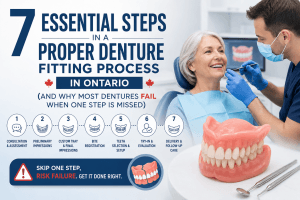
Below are the 7 essential steps in a proper denture fitting process — the same clinical foundation used in modern practices that prioritize long-term comfort over short-term speed.
1. Initial Consultation & Full Oral Assessment
Everything starts with understanding the patient, not making the denture.
A proper denture provider evaluates:
- Gum and bone condition
- Jaw alignment and bite relationship
- Existing teeth or previous dentures
- Functional needs (chewing, speech, aesthetics)
This stage defines the entire treatment plan.
If this step is rushed, everything that follows becomes guesswork.
2. High-Precision Impressions or 3D Digital Scanning
This is where accuracy begins.
Traditionally, impressions are taken using dental materials. However, modern clinics increasingly use 3D digital scanning technology, which improves precision and reduces discomfort.
Why this step is critical:
- A small error here leads to lifelong discomfort
- Poor impressions = pressure points and instability
- Accuracy directly impacts suction and retention
Many modern clinics in Ontario are moving toward digital workflows to improve consistency and reduce patient discomfort.
3. Bite Registration (Jaw Relationship Recording)
This step determines how your upper and lower teeth come together.
It affects:
- Chewing ability
- Speech clarity
- Facial balance and support
Even a minor misalignment here can cause:
- Jaw strain
- Difficulty chewing
- Long-term discomfort
This is one of the most clinically underestimated steps in denture fabrication.
4. Wax Try-In (Prototype Stage)
Before final production, patients are fitted with a wax version of their dentures.
This allows evaluation of:
- Tooth position and alignment
- Smile aesthetics
- Bite comfort
- Speech testing
This is the last opportunity to make major adjustments before final fabrication.
Clinics that skip or rush this stage often produce dentures that “look fine but feel wrong.”
5. Final Denture Fabrication (Lab Production Stage)
Once approved, the denture is manufactured.
This stage involves:
- Precision tooth setup
- Material selection
- Functional balancing
- Aesthetic refinement
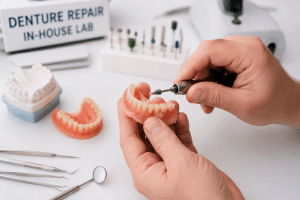
Modern clinics with in-house dental laboratories can significantly improve:
- Turnaround time
- Quality control
- Adjustment accuracy
This reduces dependency on external labs and improves predictability.
6. Final Fitting & Clinical Adjustments
When the denture is first delivered, it almost always requires refinement.
A proper fitting includes:
- Pressure point relief
- Bite refinement
- Stability testing during speech and chewing
This stage transforms a “made denture” into a comfortable functional appliance.
Without proper adjustment, even well-made dentures can feel unusable.
7. Follow-Up Adjustments & Adaptation Period
The mouth changes after initial denture use.
Gums adapt, bone reshapes slightly, and pressure distribution shifts.
Follow-ups are necessary to:
- Refine comfort
- Adjust fit stability
- Prevent long-term soreness
Clinics that skip follow-ups often leave patients to “adapt on their own,” which leads to frustration and poor outcomes.
Why Process Matters More Than the Denture Itself
Dentures are not fixed objects — they are dynamic fits.
When all 7 steps are properly executed:
- Comfort improves significantly
- Chewing becomes natural
- Adjustments are minimal
- Long-term satisfaction increases
When steps are skipped:
- Pain and soreness increase
- Dentures become loose
- Frequent repairs are needed
- Overall cost increases over time
⭐ Modern Dentistry Advantage: In-House Lab + 3D Technology
The future of denture care is shifting toward integrated systems.
Our partner clinics – Dentures On Yonge (Toronto) and GIA SMILE Dental Clinic (Hamilton) – operate with a modern clinical model designed to improve both accuracy and efficiency.
Key advantages include:
- In-house dental lab production → faster turnaround and better quality control
- 3D digital scanning technology → higher precision than traditional impressions
- Reduced patient discomfort → fewer physical impression materials
- Faster adjustment cycles → everything managed within one clinical system
This integrated workflow significantly reduces the common “trial-and-error” phase seen in traditional denture processes.
Final Thought
If you are considering dentures, the most important question is not:
“How much does it cost?”
But instead:
“What process do you follow to ensure it fits properly and comfortably?”
Because in modern denture care, the process is the product.
If you want a more precise and comfortable denture experience, our partner clinics — Dentures On Yonge (Toronto) and GIA SMILE Dental Clinic (Hamilton) — combine in-house laboratory fabrication, advanced 3D scanning technology, and streamlined clinical workflows to reduce discomfort and improve accuracy from the very first fitting.
👉 Explore services here: https://gianova.ca/dental-services