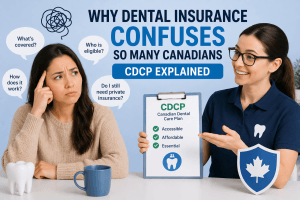
Dental insurance in Canada is supposed to make oral care more accessible and affordable. However, many Canadians are surprised to find that understanding their coverage — especially with new programs like the Canadian Dental Care Plan (CDCP) — is not always straightforward.
Confusion often leads to statements like:
- “My clinic doesn’t accept CDCP”
- “My insurance was rejected”
- “I thought everything was covered”
In reality, most of these situations are not about refusal or denial by dental clinics, but about how dental insurance systems are structured, what they cover, and how eligibility rules work.
This article explains why dental insurance in Canada often feels confusing, and what patients should realistically understand before making assumptions.
1. Dental insurance is not “full coverage” for most people
One of the biggest misunderstandings is the belief that dental insurance (including CDCP) covers all dental costs.
In practice, most dental plans in Canada work on a partial coverage model, meaning:
- Some procedures are fully covered
- Some are partially covered
- Some are not covered at all
For example, government dental coverage programs like CDCP typically include services such as exams, cleanings, fillings, extractions, and dentures — but may limit or exclude certain advanced or cosmetic procedures depending on eligibility and pre-authorization requirements.
This structure often surprises patients who expect “everything included.”
2. Eligibility rules are more complex than they seem
Another major source of confusion is eligibility.
Programs like CDCP are not universal dental insurance plans. They are designed for specific groups of Canadians who meet criteria such as:
- Income thresholds
- Lack of access to private insurance
- Residency and tax filing conditions
Eligibility is not only about current status, but sometimes also about previous access to insurance through work or other benefits.
Because of this, two people with similar income levels may receive different coverage outcomes depending on their situation.
This creates confusion for patients who assume eligibility is purely income-based or automatic.
3. “Not covered” does not always mean “refused”
A common misunderstanding is that when a treatment is not covered, the clinic is “refusing insurance.”
In reality, dental clinics generally do not decide whether a treatment is covered or not.
Instead:
- Insurance programs define coverage rules
- Clinics submit claims based on those rules
- The insurer determines approval or partial payment
This means that when something is not covered, it is usually due to policy limitations, not a decision made by the clinic.
For example, some procedures may require pre-authorization or may only be covered under specific clinical conditions.
4. Partial coverage often leads to misunderstanding
Even when coverage exists, it is rarely 100%.
Many dental plans operate with:
- Co-payments (patient pays part of the cost)
- Annual maximum limits
- Coverage percentages (e.g. 60%–80%)
This often leads to confusion when patients expect full coverage but still receive a bill.
In some cases, patients may interpret this as “insurance not working,” when in fact it is working exactly as designed — just not covering the full amount.
5. Timing and approval processes matter
Another factor that creates confusion is timing.
Dental insurance programs often require:
- Pre-estimates before treatment
- Claim approvals after submission
- Verification of eligibility at time of service
This means treatment decisions and insurance decisions are not always instant.
If patients proceed with treatment before confirmation, they may later find that reimbursement is partial or not applicable.
This is one of the most common sources of frustration in dental insurance experiences.
6. Why CDCP specifically causes confusion in Canada
The Canadian Dental Care Plan (CDCP) is relatively new, and like many public health programs, it is still being understood by both patients and providers.
Some of the confusion comes from:
- Rapid expansion of eligibility over time
- Different coverage levels based on income
- Lack of clarity between “covered services” vs “fully paid services”
- Differences between public programs and private insurance expectations
Even official guidance emphasizes that coverage depends on specific service codes, clinical need, and program rules.
This makes CDCP helpful — but not simple.
7. Why communication gaps make everything worse
A major hidden issue is not insurance itself, but communication.
Patients often hear:
- “Not covered”
- “Not eligible”
- “You may need to pay extra”
Without proper explanation, these statements can sound like rejection.
In reality, they usually mean:
- Coverage is partial
- The procedure requires additional conditions
- The claim needs review or approval
Better explanation of insurance breakdowns significantly reduces confusion.
8. What patients should do to avoid confusion
To avoid misunderstandings, patients should:
✔ Ask for a treatment estimate before starting
✔ Confirm insurance coverage details in advance
✔ Understand what is included vs excluded
✔ Request clarification on out-of-pocket costs
✔ Check eligibility requirements carefully
Being proactive helps reduce unexpected costs and frustration.
Conclusion
Dental insurance in Canada — including CDCP — is not designed as a fully comprehensive payment system. It is a structured coverage model with eligibility rules, partial payments, and treatment limitations.
Most confusion arises not from refusal or rejection, but from misunderstandings about how coverage actually works.
By understanding the difference between eligibility, coverage limits, and claim approval processes, patients can make better-informed decisions and avoid unnecessary frustration.
📩 Reach out to GIANOVA if you would like help being connected with clinics in Ontario that can walk you through your insurance coverage and treatment options step by step.